IMIT · Inborn Multiple Intelligence Test

Know your child's learning ability to analyse their career path

Every parent wants their child to grow up doing something they love. But how do you guide them when you are not sure where their real strengths lie?

Most parents wait until their child fails to figure out what suits them. A simple fingerprint analysis can help you get ahead of that.

Reach us. Know your child's potential.

Two parents and their two young daughters at a table of schoolbooks and notepads, in front of a board asking what do you want to be when you grow up, with a dozen jobs sketched around it.

ASC Inborn Analytics uses IMIT (Inborn Multiple Intelligence Test) to reveal natural strengths, learning styles, and career pathways.

  • The scan itself takes minutes, at our Manikonda centre.
  • A 45-page report follows in three to five days.
  • Then a one-to-one session with the analyst who prepared it, at the centre or on a video call.
  • The same assessment at every age, from three years upwards.
Stop guessing what your child is good at.
The answers may already be written on their fingertips.
  • Know unique abilitiesWhat comes naturally, across eight kinds of intelligence.
  • Educational guidelinesStudy methods and subject choices that fit how they learn.
  • Career choicesFields and directions worth exploring, as suggestions to discuss.
  • Personal growthWhere confidence is already strong, and where to build it.

Who is it for

Any age. One assessment.

Your child's prints are read the same way whether they are four, nineteen or more. The difference is how you mould their path.

Early Years

Three nursery-age children smiling at a yellow table, with a wooden bead maze, a shape puzzle and coloured building blocks in front of them.

Provides parents with insights to better understand their child's natural way of learning and engaging with activities. It can help in choosing experiences that encourage curiosity, confidence, and joyful learning.

  • Discover your child's inborn talents and strengths.
  • Identify their best learning style.
  • Understand their multiple intelligences.
  • Choose activities based on their natural potential.
  • Strengthen the parent-child relationship.
  • Talk to their teachers with a clearer picture of how they learn.

Teen Years

Four school students in uniform standing together outside, school bags on their shoulders.

Encourages students to become more aware of their natural preferences and abilities as they prepare for important academic decisions. It can help them approach subject selection and future planning with greater clarity.

  • Discover your personal quotients: IQ, EQ, AQ, CQ and SQ.
  • Identify your analytical and creative strengths.
  • Understand your innate potential and abilities.
  • Discover your acquiring style, single-tasker or multi-tasker.
  • Gain insights to help you choose the right path for your future.

Young Adults

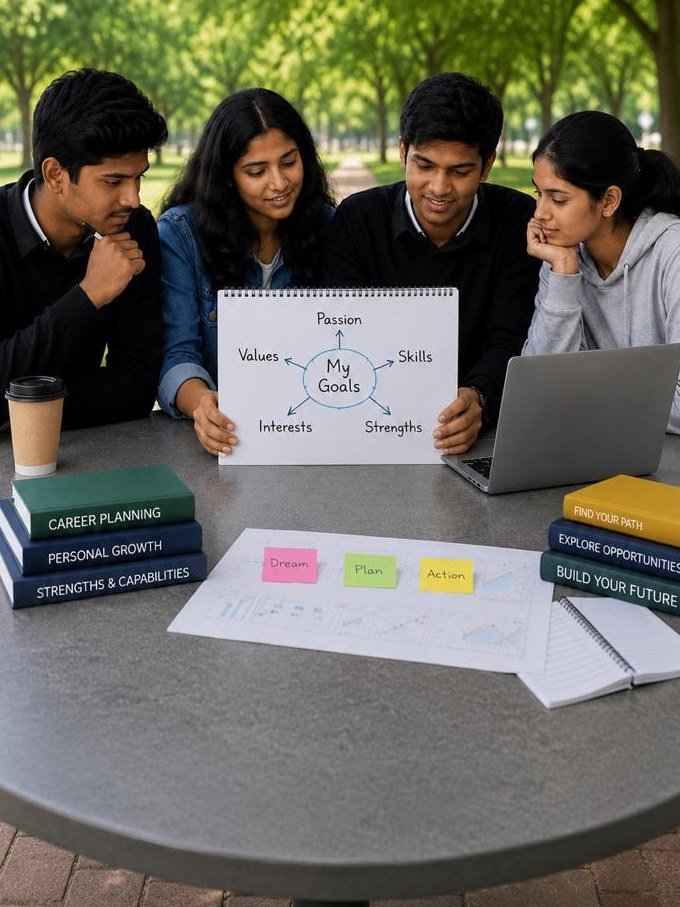
Four young adults around an outdoor table, two of them holding up a notepad with a mind map headed My Goals branching out to passion, skills, strengths, interests and values.

Provides a deeper understanding of individual preferences and capabilities to help navigate important life and career choices. It can support personal growth and help individuals identify pathways where they can thrive.

  • Discover your personality type and unique traits.
  • Identify your core competencies and strengths.
  • Explore your multiple intelligences and potential.
  • Understand your strengths and areas for improvement.
  • Identify suitable learning, career, and leadership qualities.

How we know what we know

No mystery about the method.

We tell you exactly what is read, how it is mapped, and who does the work. That's how you know the process is clear and guided with care.

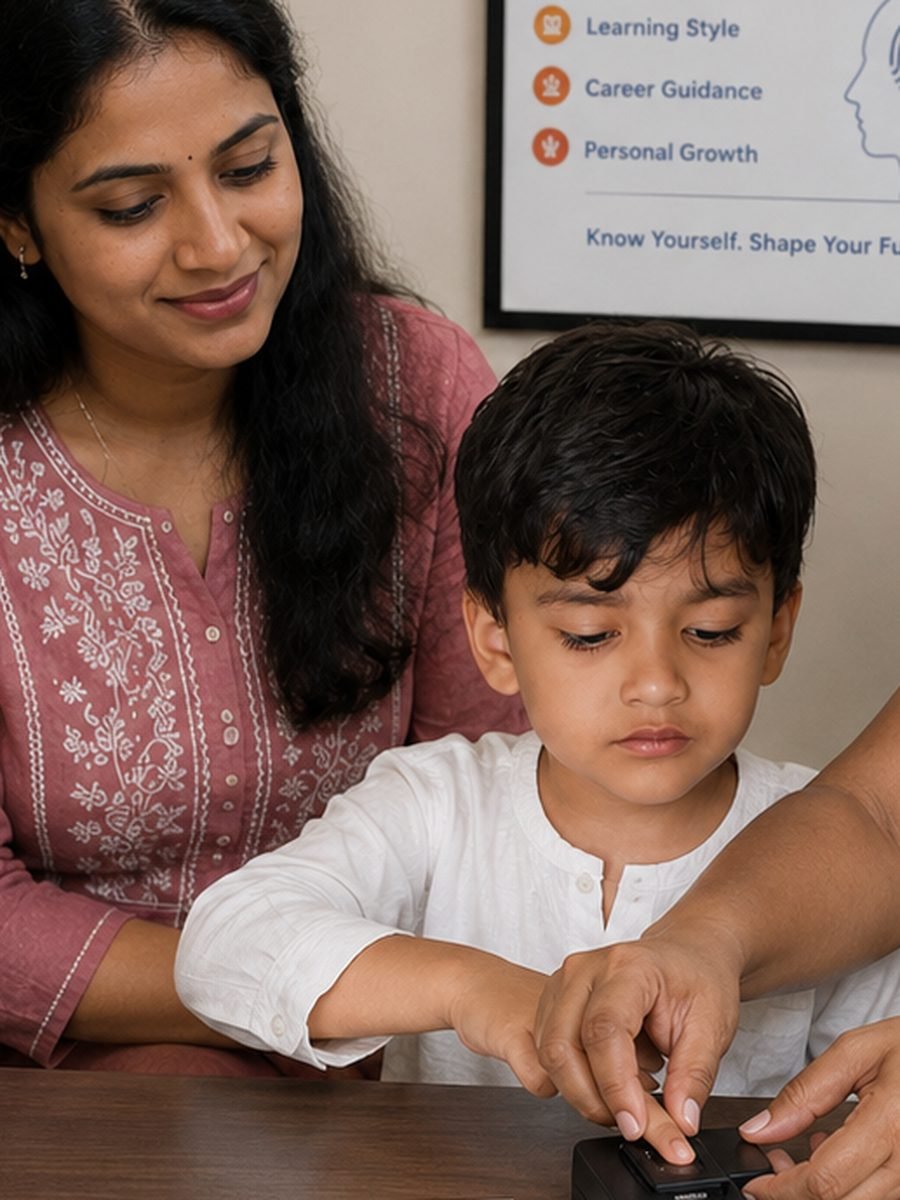
A young boy resting his fingertips on a fingerprint scanner on a desk, guided by an adult hand, with his mother sitting beside him and watching.
  1. The pattern was set before your child was born

    Fingertip ridges form in the womb and then stay put. Skin that is cut or grazed grows back in the same pattern. Very little else about a person is fixed that early and then simply stays fixed.

  2. Reading those patterns is a hundred-year-old discipline

    Dermatoglyphics is the study of fingertip patterns. Anatomists and anthropologists have been sorting them into arches, loops and whorls, and counting the ridges between fixed points, for well over a century.

  3. The results are mapped onto a model you may already know

    Howard Gardner's Theory of Multiple Intelligences, published in 1983 and taught widely in education. Eight intelligences rather than one score, which is closer to how most parents already describe their own children.

  4. The mapping is a fixed set of rules, applied the same way every time

    The same prints produce the same profile, whoever runs it and whenever they run it. The analysis is done on licensed professional software, and our analyst is certified to run and interpret it.

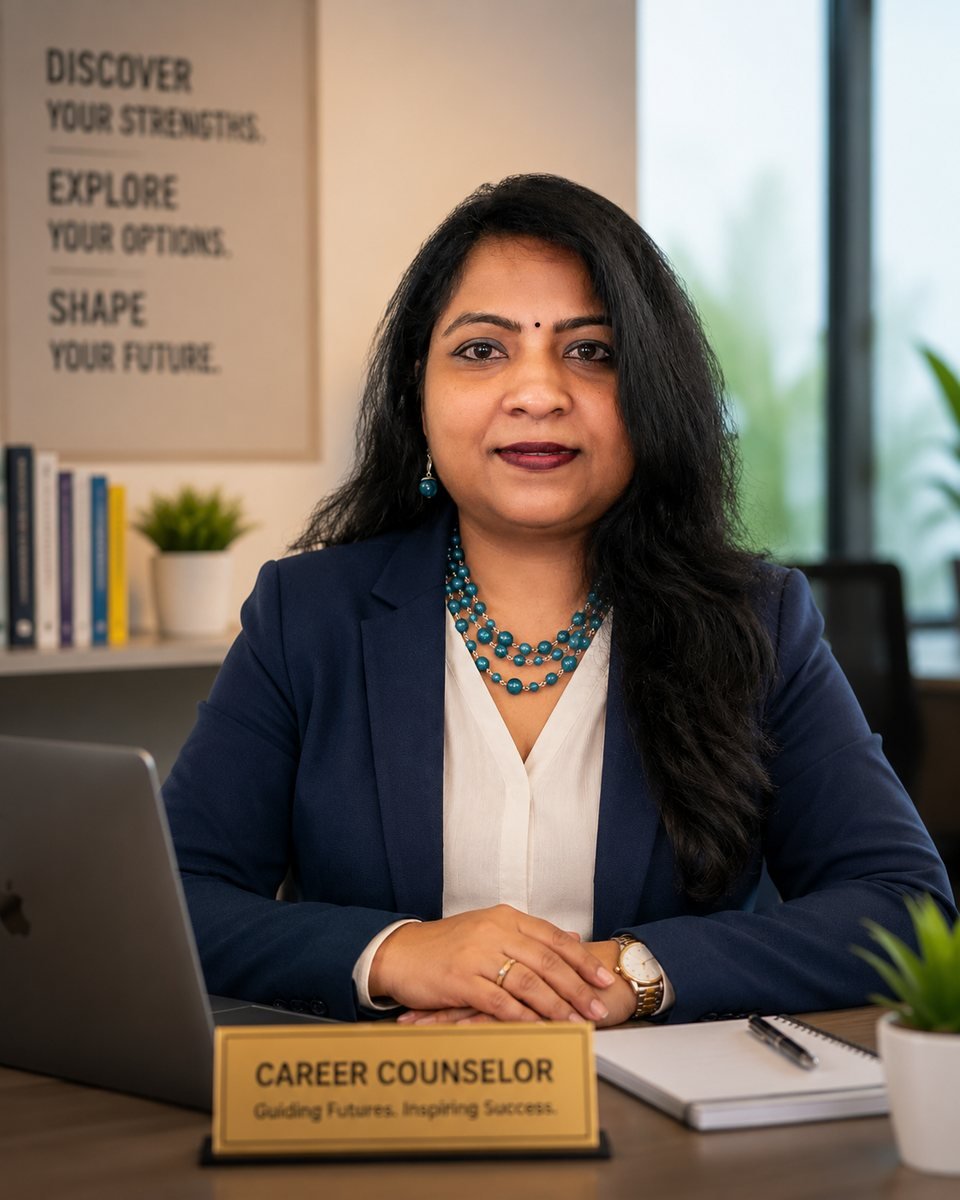
The certified career counsellor at ASC Inborn Analytics, at her desk in the Manikonda centre.

Who sits across the table

Click to know more

Our analysis is conducted using licensed professional software by a certified analyst trained to carefully interpret the results. Each session is personally handled by the analyst, ensuring that your findings are clearly explained and understood. We take the time to discuss your results, answer your questions, and provide personalised insights and guidance based on your unique profile.

Chethani Goru Certified Career Counsellor ASC Inborn Analytics, Manikonda

What we do

Discover your inborn potential. Understand your strengths. Shape your future.

At ASC Inborn Analytics, we use IMIT (Inborn Multiple Intelligence Test) (opens in a new tab) to understand an individual's innate potential, natural strengths, multiple intelligences, and learning preferences. Our process combines structured analysis with personalised guidance to help you make better decisions about learning, development, and career.

Capture your unique patterns

We begin by capturing your unique dermatoglyphic (fingerprint ridge) patterns through a simple, safe, and non-invasive scanning process. These patterns are then securely recorded and prepared for detailed analysis using our IMIT assessment system.

Takes a few minutes

Understand your inborn potential

Your unique ridge patterns are carefully analysed using licensed professional software to identify your natural strengths, multiple intelligences, learning preferences, and innate potential. The findings are compiled into a personalised report that provides valuable insights into your unique profile.

Three to five days

Turn insights into direction

A Certified Career Counsellor personally explains your report and helps you understand your strengths, abilities, and areas for development. You receive personalised guidance to make informed decisions about education, personal growth, and future career pathways.

In person or online

Know the abilities you're born with. Get guidance tailored to you. Understand your natural strengths. Find the right direction for your future.

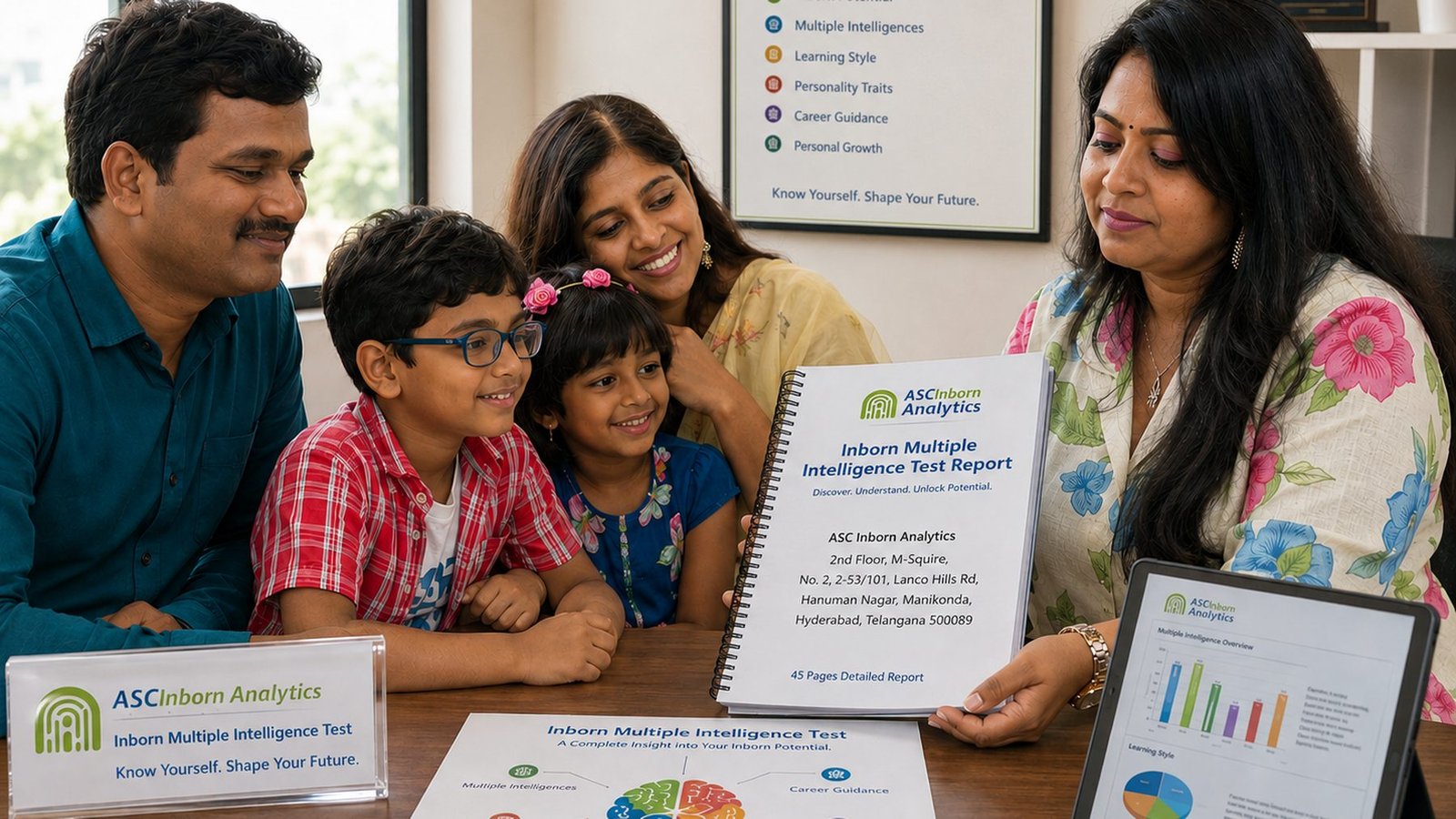
A counsellor holding open a spiral-bound IMIT report across a table for two parents and their two children, who are leaning in to look at it.

What you get

Your inborn potential, mapped out in detail

A comprehensive 45-page report covering inborn abilities, multiple intelligences, personality traits, learning styles, strengths, potential, and suitable areas for growth and development.

  1. 1–10Pages

    How your child learns

    The balance between what they take in by observing, by listening and by performing. It is given as a balance, not a label, because almost nobody is only one of the three. Then separate study pages and separate exam pages, written for each channel.

  2. 11–26Pages

    The intelligence profile

    All eight of Gardner's intelligences. Each one appears twice: what it looks like in your child day to day, then a full page of things you can actually do to strengthen it.

  3. 27–32Pages

    Personality and working style

    The personality type in plain language, a summary you could hand to a class teacher, a personal SWOT, and how this style tends to get along with other styles, at home and in a classroom.

  4. 33–36Pages

    The brain profile

    Left and right distribution, and what that suggests about how your child approaches a problem: plan the whole thing first, or start and adjust as they go. Neither one is better than the other.

  5. 37–40Pages

    The four quotients

    IQ, EQ, AQ and CQ: reasoning, handling emotion, coping when things go wrong, and making something new. Most families have only ever heard of the first one.

  6. 41–45Pages

    Direction

    Subjects that suit the profile. Streams and departments. Activities worth trying this term. Career preferences by field. All of it as suggestions to discuss, not instructions to follow.

Observing, listening, performing

Pages 1 to 10 work out your child's own balance between the three. Almost every child has some of all three, which is exactly why a single label like "visual learner" is not much use to anybody.

Observing

Diagrams, colour coding, mind maps, written summaries. Show it before you say it.

Listening

Reading aloud, explaining it back to you, discussion, recorded notes played twice.

Performing

Worked examples, models, building the thing, moving around while revising.

Eight ways of being clever

Pages 11 to 26, condensed onto one screen. The report tells you where your child sits on each. Here is what each one looks like, and one thing you could start this weekend.

Linguistic

Looks like
Words, reading, telling it back to you in their own version.
Strengthen it with
Debate, journalling, reading aloud to someone younger.

Logical-mathematical

Looks like
Patterns, reasons, sequences. Asking why until you run out.
Strengthen it with
Puzzles, strategy games, finding a second method.

Spatial

Looks like
Pictures, space, how things fit together in their head.
Strengthen it with
Drawing, models, maps, taking things apart.

Bodily-kinesthetic

Looks like
Learning through the body. Restless when made to sit still.
Strengthen it with
Sport, dance, cooking, anything made by hand.

Musical

Looks like
Rhythm, pitch, pattern in sound. Tunes stuck in the head.
Strengthen it with
An instrument, singing, setting facts to a tune.

Interpersonal

Looks like
Reading a room, working with people, noticing moods.
Strengthen it with
Group projects, teaching a classmate, team roles.

Intrapersonal

Looks like
Knowing their own mind. Needs to think before answering.
Strengthen it with
Quiet time, journalling, choosing their own goals.

Naturalistic

Looks like
Living things, sorting, classifying, the outdoors.
Strengthen it with
Gardening, pets, collections, field trips.

Ask us anything

Send us a question, or just call.

Tell us a little about your child and we will come back to you. If you would rather talk to a person now, WhatsApp is the fastest way to reach us.

We use these details only to answer your enquiry. A child should never fill this in. It must be a parent or guardian.

Almost there. One tap to send it.

Everything checks out. Because our online form is not connected yet, your message is ready to go by WhatsApp instead. Tap below and it will open with your details already written out, so all you have to do is press send.

Reach us directly

  • Centre

    2nd Floor, M-Squire, D.No. 2-53/101,
    Lanco Hills Rd, Hanuman Nagar,
    Manikonda, Hyderabad, Telangana 500089

  • Phone & WhatsApp +91 88862 12363
  • Visiting

    By appointment. Message us and we will fix a time that suits you.

Open the centre in Google Maps (opens in a new tab)

Questions

What parents ask us first

Not answered here?

Send us a message. We would rather answer a question now than have you wondering about it at the centre.

Ask a question
Does the scan hurt?

No. Your child rests each finger on a glass scanner plate, one at a time. There is no ink, nothing sharp and nothing that touches the skin except the glass. Most children are curious about it rather than nervous.

Does my child need to prepare for it?

Nothing at all. There is nothing to revise and no way to do badly at it. Clean, dry hands are the only thing that helps. Please do not tell your child they are going for a test. It is a scan, and it takes minutes.

What if my child won't sit still?

Perfectly normal, especially under seven. We go at your child's pace and take breaks if we need to. Plenty of younger children do the whole thing sitting on a parent's lap.

How soon do we get the report?

Three to five days after the scan. We call you as soon as it is ready and fix a time for your session, evenings and weekends included.

What ages do you assess?

From three years upwards, in three bands: 3–10, 11–17, and 17 and above. The assessment itself is identical at every age. What changes is how the report is written and who it is really addressed to.

Can the session be online?

Yes. The scan has to happen at our Manikonda centre, but the session afterwards can be at the centre or on a video call, whichever is easier for you. The printed report reaches you either way.

Do you keep my child's fingerprints?

The prints are used to produce your report and for nothing else. We do not sell them, share them or publish them. They are deleted automatically fifteen days after your report is prepared. If you would like them deleted sooner, tell us and we will delete them.

Is this a medical test?

No. IMIT is not a medical or diagnostic test, and it does not identify or rule out any condition. It describes learning style and intelligence profile as a starting point for a conversation about your child. For anything to do with their health, please see a doctor.

Do you come to our home, or to schools?

Not yet. The scan happens at our Manikonda centre only. The session afterwards is the part that can happen anywhere, by video.

What do we actually walk away with?

A spiral-bound printed report of forty-five pages, a digital copy of the same, and a one-to-one session with the analyst who prepared it. Full details are on the booking page.

Ready when you are.

One scan, one report, one conversation. Book a slot at the Manikonda centre and we will take it from there.

Book a Test Now